The hardest part of S/MIME encryption has never been the cryptography. It is getting the recipient's certificate before the first message.
Today we are publishing a draft of S/MIME Certificate Discovery (SCD), a small, open specification that lets a mail gateway or mail client find the certificate for an email address, or for a whole domain, automatically, before any message is sent.
How it works, in three lines:
- A domain announces that it publishes certificates with one DNS TXT record.
- The certificates are plain files on a web server at a fixed name, smimecert.yourdomain, fetched over HTTPS.
- A certificate found this way is checked exactly as one that arrived in a signed message: it must chain to a CA you already trust, name the right address, and be valid and unrevoked. SCD finds certificates. It never decides trust.
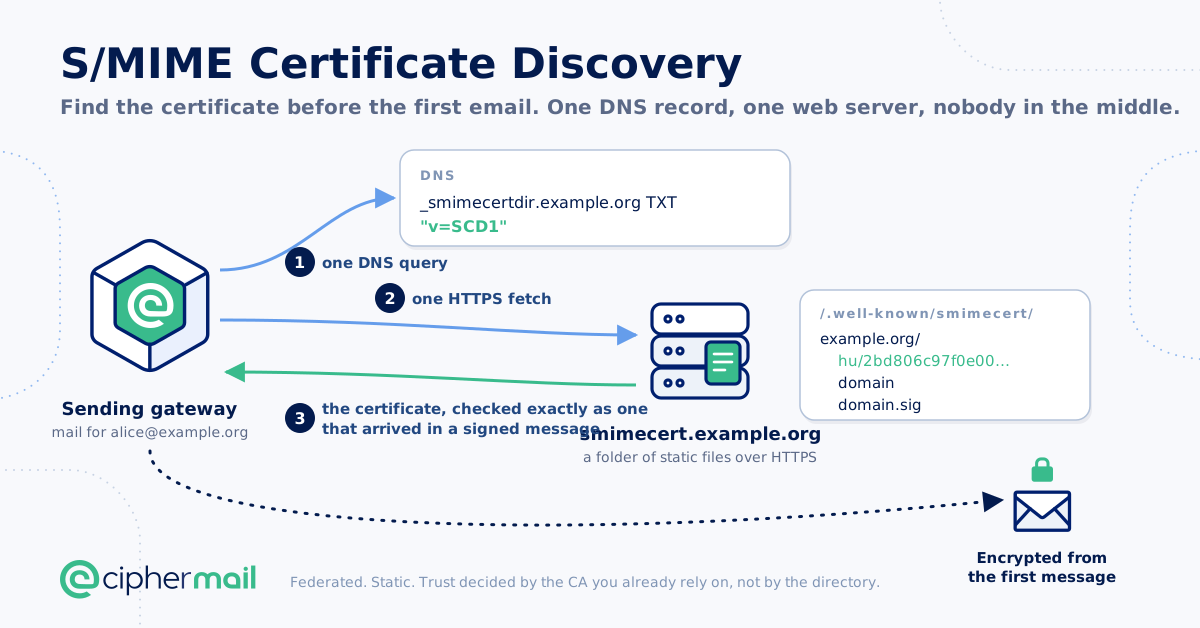
What makes it different from a key server or a certificate portal is that there is nobody in the middle. SCD is federated, like email and DNS themselves: every domain publishes for itself, in its own DNS zone and on its own web server, with no registry, no enrolment and no central operator who sees who is about to write to whom. A static folder of files is a complete installation. Two organisations that both publish benefit immediately, whatever the rest of the world does.
For organisations that encrypt at the gateway, SCD also supports a single domain certificate, signed by the domain itself, so that a sender needs one DNS query and one fetch for an entire correspondent organisation.
The design borrows deliberately from MTA-STS and from the OpenPGP Web Key Directory, and it works without DNSSEC: a blocked or tampered lookup can only ever add nothing, never take a certificate away.
We are building SCD into the CipherMail Gateway, for publishing and for lookup, and we would like other implementers to pick it up. The draft is open for comments: